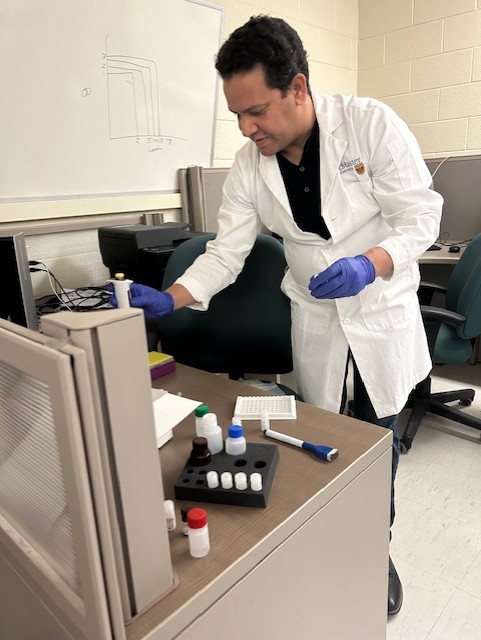
Alumni Spotlight: Dr. Dennis Kolosov

How very hungry caterpillars grow and grow and don’t get sick
Dennis Kolosov, McMaster University
What if I told you that right in your backyard there lives a creature that eats five times its weight every day and grows a thousandfold in weeks. Instinctively, you’d probably want to stay away from the gluttonous beast! However, it wouldn’t be interested in you at all — in fact, it’s a vegan. Feel safer now?
Well, you shouldn’t.
You may have come across this gluttonous beast in kindergarten: the hungry hungry caterpillar, who ate his way through pages of food. Humanity loses $470 billion of food to crop pests like caterpillars every year. To put this in perspective, this is how much money Austria (yes, the whole country) made in 2018 (its gross domestic product).
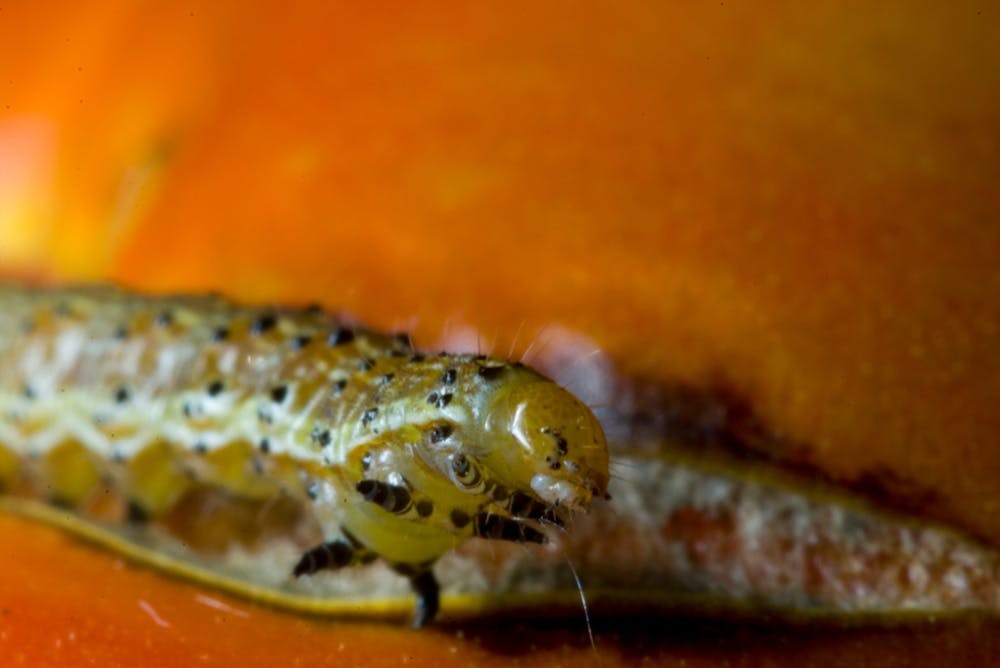
Caterpillar growth
Caterpillars turn into butterflies and moths, which are important pollinators of plants and crops. So, this group of insects is like a very nice couple with a few very annoying kids.
Caterpillars have to grow a thousandfold in weeks, while eating nothing but leaves. In order to digest plants better, caterpillars produce a corrosive (very basic pH) environment in their guts, similar in properties to commercial cleaning products.
In addition, plants that are fed on by insects produce toxic chemicals to defend themselves from predators, which caterpillars must be able to render harmless. Rapid growth usually requires the best food and easiest metabolism. So, how does a creature that feeds on toxic plants and produces detergent in its gut grow so rapidly?
There is no delicate way of putting it: caterpillars are able to do this by pooping (not addressed in this article) and peeing effectively. Until now, how insects pee has been studied in mosquitoes and flies, but not caterpillars. But you can’t learn how a whale pees by studying a camel.
Caterpillar kidney design
For the past five years, members of Michael O’Donnell’s lab at McMaster University (including myself) have been investigating how excretion works in caterpillars. It turns out that caterpillar kidneys — outpouchings of the gut termed Malpighian tubules — have several cool adaptations that enable caterpillars to safely consume so much food.
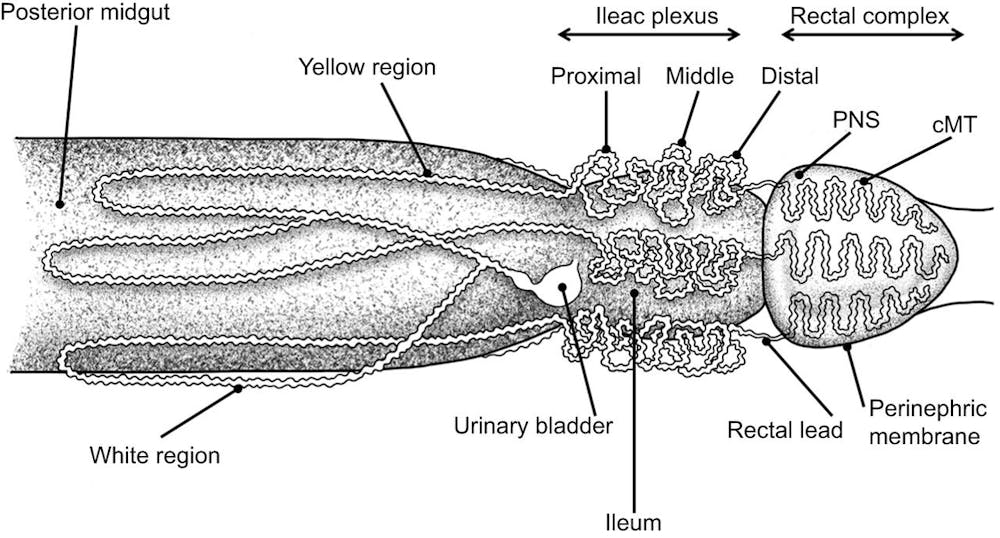
Caterpillar kidneys are much more complex when compared to those of other insects — they are closer in complexity to human kidneys than those of adult moths and butterflies of the same species. Generally, animal kidneys require water flow from blood into the kidney because toxic wastes need to be dissolved in water so they can be excreted.
Caterpillar kidneys are connected to the intestine, enabling them to extract water from their food instead of using water from their blood. In fact, not only do caterpillars power their excretion with gut water, they use their kidneys to transfer some of the gut water into their blood, which helps them to grow rapidly.
However, this arrangement doesn’t work when there’s not enough water in the gut. In this case, the caterpillar kidney switches to using the water from their blood, so it can work uninterrupted. This allows their kidney to use water from the caterpillar’s blood to produce urine.
This switch is very rapid and involves some of the same mechanisms muscles and nerves use to respond to stimuli. This allows the caterpillar to work their kidneys non-stop regardless of whether it’s feeding or not.
Caterpillars’ kidneys can recirculate the same water to excrete metabolic wastes more than once, minimizing how much water they lose to peeing.
Caterpillar research
It took us several years to begin understanding how caterpillars could switch between using water from blood or intestine to power their kidneys and why it is safe for caterpillars to do so.
Our work at McMaster University shows us how caterpillars have highly efficient kidneys that enable their growth. Understanding this can help us interfere with their feeding on our crops. Of particular importance is how the caterpillar kidney is different from that of other animals (including us). This will ensure that any control strategies implemented will not affect the bees, birds and humans in the same habitat.
Now, more than ever, while faced with COVID-related food shortages, we must be cognizant of where our food comes from and what it takes for it to get to us. Finding out how caterpillars pee will help us put a dent in that $470 billion of crops we lose to insect pests every year. 
Dennis Kolosov, NSERC and McCall MacBain Postdoctoral Fellow; Sessional Lecturer; oCUBE Communications Committee Chair, McMaster University
This article is republished from The Conversation under a Creative Commons license. Read the original article.
Related News
News Listing